Anthony Natsoulas

Ceramic Sculpture

Click on picture to see larger version!

Photo by Kurt Fishback


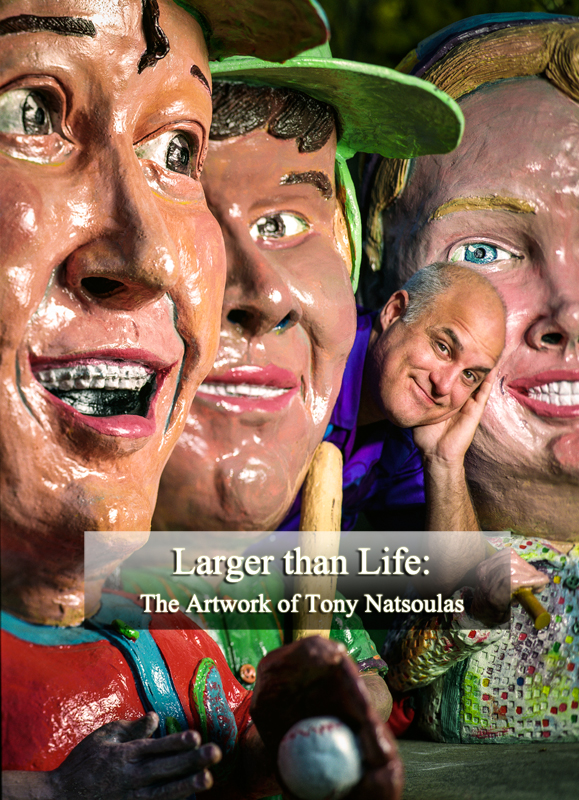
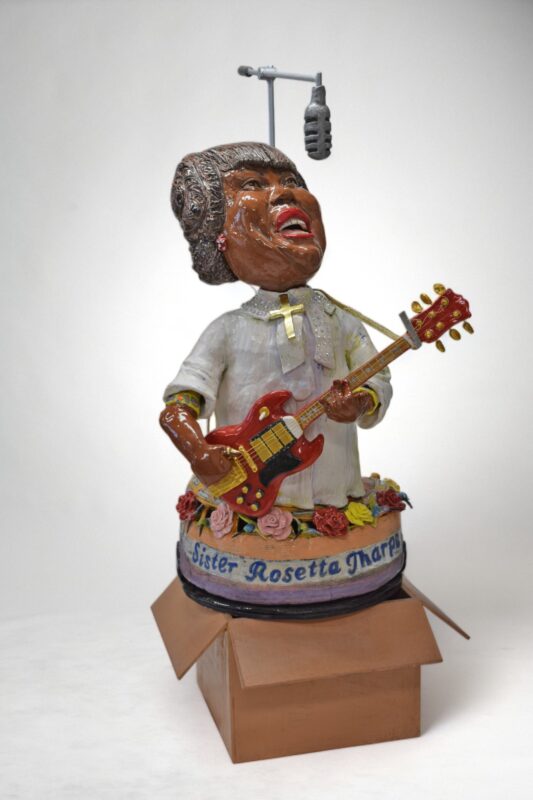
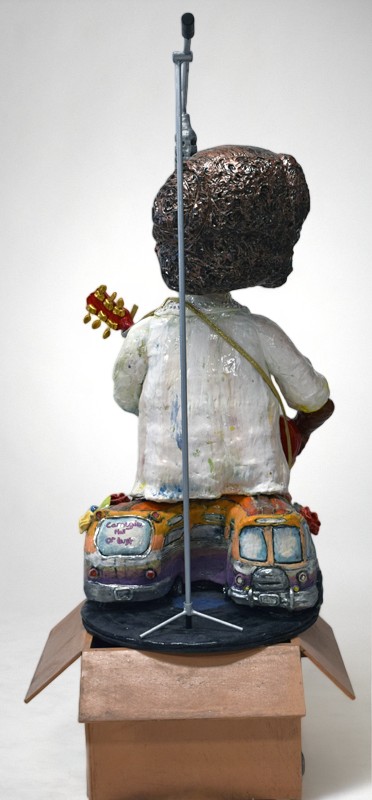
After receiving his Masters of Fine Art at the University of California at Davis in 1985, Tony has been working as a professional artist in ceramic sculpture. His main interest has been in large scale humorous figurative ceramic sculpture. In undergraduate and graduate school he was fortunate to have studied at the University of California, Davis' TB9 ceramic studio with the artist that put figurative ceramic sculpture on the map, Robert Arneson. Since then he has been showing in galleries and museums around the world and has been commissioned to do several public and private sculptures in bronze, fiberglass and ceramic. Please do not hesitate in emailing at directly about purchasing or commissioning a sculpture. Tony maintains a studio in Sacramento, CA. 916 349 2324


Since I was a child, I have been making, breathing, and living art. My parents took me to museums in the ’60s and ’70s in New York City while visiting relatives. I was in high school and was trying to figure out what to do with my life. I did not want to do a receptive job; I wanted to do something creative, so I chose art. I figured I was good at art after winning prizes in high school art contests. While still in high school, I took some classes at the University of California, Davis, where Robert Arneson was teaching. People bought my work, and I got a positive reaction to my art even at a young age, so I wanted to make a go of living off of my artwork, and working doing something I loved and enjoyed.

I have been able to make my living making my art. The folks who buy my work are fine art collectors, museums, craft collectors, restaurant owners, gallery owners, teachers, curators, friends, neighbors, and cities that commission me to do pieces for them. I also do workshops and PowerPoint lectures for schools and websites.

As far as promotion goes, I have put together a large website, and do public presentations for commissions. I have landed several museum shows by sending the directors and curators a portfolio and résumé. I have been fortunate; people aware of my art, our art collection, who have seen a show, seen me lecture, or do workshops, have asked to feature my work in articles, books, magazines, television, and such. Kind of like a snowball effect, I put myself out there and it grows from there. I also send announcements via email and Facebook when ever I finish a new sculpture or am having a show.

The advantages of how I market are that I get to control my own career, prices, money, how my art is represented and presented—and whom I want to see it. The money I earn is not split with anyone but my wife and cat. The artist is his or her own best advocate. When you control what is sent out on your behalf, you know it is all to your high standards and that the material written is correct. I can feel good about how I am being represented, because I take the responsibility in representing myself for the most part.

Current economic conditions really haven’t made me change or adjust anything. I am able to do more of my own work, now that the public commissions have slowed down. And my perception of the sculptor’s life hasn’t changed much over time. I have one rule: If you keep your overhead down, you have the freedom to do anything you want and enjoy. It has certainly worked for me.

I look at as much art (all mediums) as I can. I go to museums, galleries, studio visits, lectures, art and craft shows, talk to fellow artists, subscribe to many magazines, travel, go to movies, and am always aware of what is out there and what is going on in the world.

Ceramics should not be in a category by itself; it should be just another medium in the fine arts world. I don’t get it when I hear that critics don’t understand or know about ceramics so they can’t write about it. It is just another sculpture. Why do we have any shows, magazines, collectors, galleries or museums dedicated to one media? I don’t get it.

When I graduated from undergraduate school and was going to off to Maryland Institute College of Art, Arneson said to go to New York City and get a gallery and a studio. I wanted to keep making large-scale ceramic sculpture and could not see how I could do it there due to the high cost of living and the lack of big, affordable studio space. I have several friends who went to New York and had to wait tables and try to get artwork done in their time off. I feel like I may have missed out on getting a good fine arts gallery to represent my work on the East Coast at that time, but I think by staying here on the West Coast, I got a lot more work done. Looking at it now, I think I made the right decision for myself.

I am on health insurance through my wife’s work. Before that, we paid for our health care every month and the premiums were very expensive. I have never mixed glazes or clay due to the danger it poses to have dry chemicals and dust floating around the studio. My philosophy is that the commercial glaze and clay companies mix this stuff better and more efficiently than I do, with more consistency. I do try to stay fit and have in the last year given up using all leaded glazes on my work after finding more lead in my blood than the average person. Since then, it is lower than the average person. I try to wash out my studio once a week, and keep the large garage doors open so that I am not breathing that much dust from the clay and glazes I use.

If you’re interested in pursuing sculptural ceramics as a profession, take control. Be responsible for yourself, your art, and your own career. Be involved with every aspect of the business and keep your overhead as low as possible. Also, make what is in your heart and what you love or have some passionate feeling about. Get to know your medium, what it can do and what it can’t do. Learn your technique; you have to learn to spell and put words together before you can write a great poem. Look, look, look at everything and as much art as you can. Also, try to stay as humble as you can.

Tony Natsoulas is not affiliated in any way with the John Natsoulas Gallery or John Natsoulas.
Share  

Please click on links for more information


Latest Show

All Ceramics and Nothing But Ceramics

Gualala Arts

www.gualalaarts.org

Ceramic art precedes European cave art and is certainly one of the oldest expressions of the human need to create. Entire prehistoric cultures are primarily known through their pottery.

The All Ceramics and Nothing But Ceramics exhibit during the entire month of June, 2012, is intended to be homage to this priceless medium and to those who use it in our community.

The intent is to fill the gallery with the most diverse array of contemporary ceramic art produced by artists in the community, which is loosely defined as any ceramicist who knows about the show. Both two and three dimensional pieces, high or low fired works, glazed or unglazed entries without regard to functionality are welcome to this non-juried show.

Doric Ball #3
The only limitations placed on the artist is that whatever is submitted be ceramic and that it be produced within the last two years and not have been on display previously at Gualala Arts Center. Up to three entries per artist will be accepted. Preferably, everything submitted should be for sale, although not-for-sale work may be included with the consent of the curator.

This show, curated by Doric T. Jemison-Ball and Sharon Nickodem, opens in the Burnett Gallery on Friday, June 1, 2012 and runs the entire month through Sunday, July 1, 2012. The deadline for submissions is May 1, 2012.


Latest sculpture

Producer of Preposterous Pictures of Peculiar People Who Prowl This
Perplexing Planet
Ceramic
2012

Basil Wolverton - SpacehawkBasil Wolverton was born in 1909, so when comic books began to look for original material in 1936, he was ready and willing. Self-taught, he tried to sell his first newspaper strip at the age of 20. Unfortunately some other strip beat him to the punch. Marco From Mars could have captured the public's fancy the way Buck Rogers did.

Wolverton was one of the earliest creators of new material for the new comic book market. He lived in Vancouver, Washington and was one of the very few comic book artists who didn't live in New York. Working totally through the mail, Wolverton took his s-f strip concepts and turned them into Spacehawk and Space Patrol and Meteor Martin. Unfamiliar comic companies like Centaur and Novelty produced anthology comic titles in the Thirties and Forties. Spacehawk appeared in Circus comics in 1938 with a reincarnation at Novelty's Target Comics in 1941-42.

Basil Wolverton - Spacehawk 2The art was both controlled and organic at the same time. Aliens lived on strange worlds in dwellings that resembled nothing as much as a cross between medieval castles and Earthly observatories. The landscapes were dotted with flora that often resembled earthworms in muffs, yet the basic building blocks of alien technology were the rivet and the steel panel. What Wolverton lacked in imagination he more than made up for with enthusiasm and drawing skills. Both the sample upper right and at left are from Target V2:1 from March 1941. By the middle of 1942, Spacehawk was earthbound, fighting Nazis and by the end of the year he'd been replaced.

Basil Wolverton - Powerhouse Pepper 2Always a comedian, Wolverton had toyed with vaudeville and radio in his younger days. Taking his unique brand of alliterative, punny humor, he got in touch with another comic book company (Timely, later to be Marvel Comics) and created one of his most endearing characters, Powerhouse Pepper. Powerhouse was a bald little runt in a striped turtleneck who could out-muscle Popeye. The strips were laden with silly signs and wacky dialog that are the obvious inspiration for much of the tom-foolery in which Kurtzman and Elder were to indulge a decade later at Mad! Throughout the forties, he created and illustrated a cadre of weirdos that peppered the pages of practically all the Timely humor and teen titles. Indicative of things to come was the occasional side by side appearance of a Wolverton and a Kurtzman contribution. (Harvey Kurtzman's most famous pre-Mad creation was Hey! Look, also for Timely.)

Also during the Forties, BW worked for Fawcett and Gleason, two of the larger comic producers, doing strips with silly titles like Bing Bang Buster, Scoop Scuttle, Mystic Moot, etc. It was in 1946 that Basil got his greatest publicity break when he won the Lena the Hyena contest. Al Capp had created a character in his Li'l Abner newspaper strip named Lena the Hyena who was supposed to be too ugly for Capp to show in a family newspaper. Her every appearance was marked by an editorial disclaimer covering her features claiming that her face was being suppressed for the greater good of mankind. Well, this was surely a great running gag, but Capp had pretty much painted himself into a corner when the readership demanded that her face be shown. Nothing that Capp could come up with was likely to be horrid enough to justify the gag. So he started a contest to have readers submit what they thought Lena looked like and a celebrity panel comprised, supposedly, of Boris Karloff, Frank Sinatra and Salvador Dali would determine the winner. Wolverton submitted his entry along with a half a million others and he won! Lena (above, at the right of his signature) netted him $500 and she appeared in the Li'l Abner strip and on the cover of Life magazine. You can read all about it in the Kitchen Sink Li'l Abner reprint series, volume 12.

Basil Wolverton - Robot WomanBasil Wolverton - Swamp MonsterHis drawing of Lena marked the origin of a new school of art: The Spaghetti and Meatball school of design. It'd be nice to say that his career suddenly took off, but the printed evidence shows continual contributions to the same customers. What did change, though, was the comic book market. Horror became a fast-selling genre, and who but Basil Wolverton was better to depict true horror? Oddly enough, no matter how horrible his panels were, there was always such an element of the absurd present that they never went totally overboard. Spaghetti and meatballs are somehow intrinsically non-threatening. (left is from Robot Woman in Mister Mystery from 1954, right is from Weird Mysteries, 1953.) He did horror stories for Atlas (post-Timely, pre-Marvel) where he illustrated two stories in 1952 written by Daniel Keyes. Keyes went on to write the Nebula Award-winning Flowers for Algernon, which was the basis of the film classic, Charlie.

In 1954, he also did a Lena-inspired cover for Mad Comic Book and inside that issue he did a feature on what the readers of Mad looked like. He did a couple more contributions to Mad, then retired from comics in 1955.

Photo by Izzy Schwartz.


This sculpture of Eddie Izzard is on a Showtime interview with Eddie.
Please see it here at YouTube. http://www.youtube.com/watch?v=_dFu4o0mkoE

Ceramic Sculpture

"Covered in Bees!"
(Portrait of Eddie Izzard)
37" x 24" x 38",Ceramic and Copper tubing
Collection of the Artists
Ceramic Sculpture


See the making of "Big Daddy Roth" on YouTube here.


Painted Bronze Sculptures at Stribley Community Center in Stockton, CA

Tony received a commission at the Stribley Community Center in Stockton, CA to sculpt three painted bronze sculptures.
They are installed at the children's water park in the Community Center's court yard. These pieces were cast at the
Artworks Foundry in Berkeley.

.

"Lee counts his snails under the Bodhi Tree" 40" X 28" X 18 " 2009

On page 131.


Tony holds an on going open ceramic sculpture studio workshop at Alpha Fired Arts in Sacramento.
Wednesdays: 6:00 PM – 8:30 PM
New Students start every Wednesday Night.
For more information click here

Alpha Fired arts, Sacramento, CA

eXTReMe Tracker